
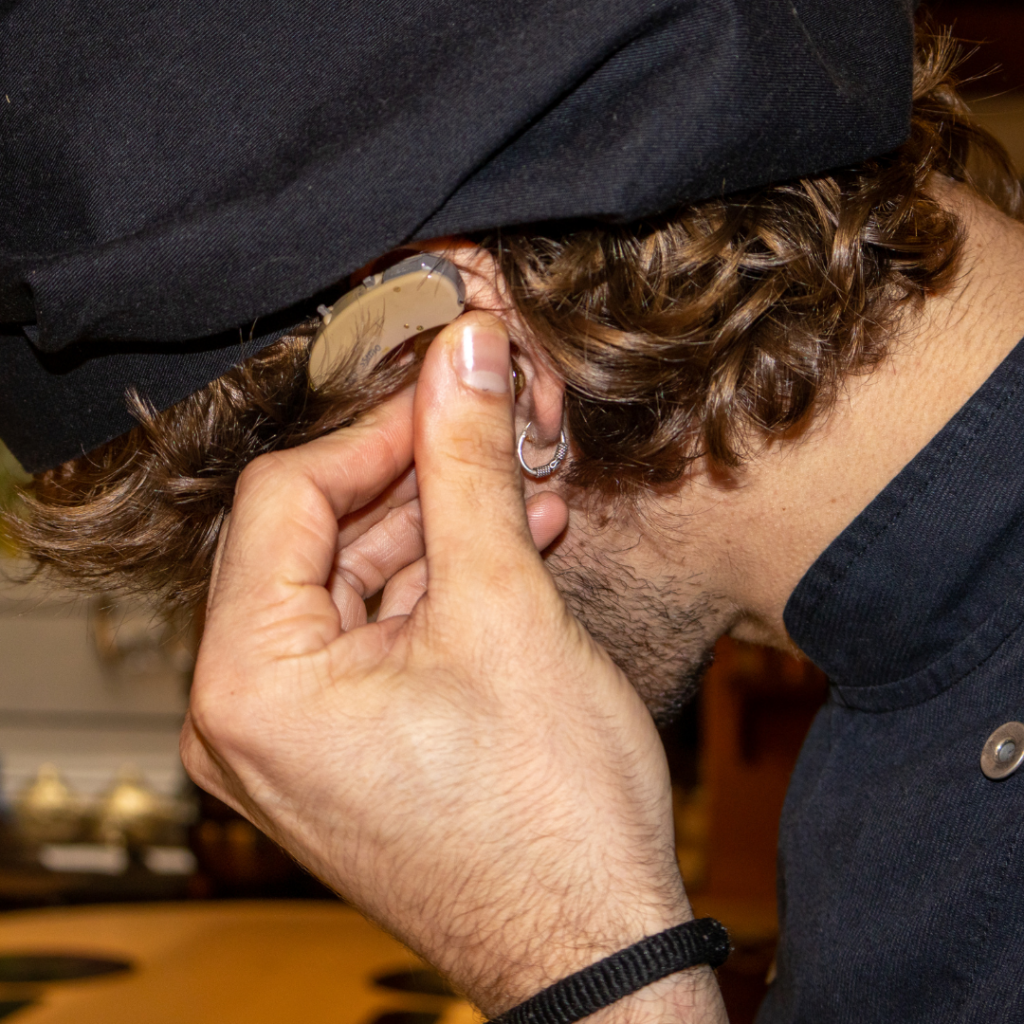
Tracking speech in busy dining venues can feel exhausting when environmental noise drowns out your hearing. Our clinical team can evaluate hearing across quiet settings and background-noise environments to pinpoint specific auditory challenges. After diagnosing the source of your difficult hearing, we design targeted interventions tailored to your listening needs.
How Can Hearing Seem Normal at Home but Fail in a Restaurant?
In quiet conditions, an optimal signal-to-noise ratio ensures that the desired speaker sounds markedly clearer than surrounding sound. Busy dining establishments generate the exact reverse scenario. Background voices, loud music, service clatter, and wall reflections collide with spoken words, demanding heightened cognitive processing to isolate individual speech.
These communication barriers frequently indicate high-frequency hearing loss, central auditory-processing disorders, or age-related sensorineural changes. Factors including listening fatigue, poor dining lighting, acoustic distance, and wandering attention make comprehension significantly harder. It is common to display normal baseline audibility on conventional hearing tests while failing comprehensive speech-in-noise testing. Inability to track speech in crowded restaurants merits audiological evaluation even when standard daily hearing sounds completely normal.
Diagnosing High-Frequency Hearing Loss and Clarity Issues
Our diagnostic process starts with a detailed case history reviewing problematic listening scenarios, occupational noise exposure, tinnitus, ototoxic medications, and familial genetics.
Pure-tone audiometric evaluations measure the absolute quietest sounds audible across specific octave frequencies using air and bone conduction. Patients with high-frequency hearing loss typically exhibit a sloping audiogram configuration where sensitivity steadily declines at elevated pitches. Comprehensive evaluations frequently include impedance tympanometry to examine middle-ear function and recorded word-recognition testing to measure speech understanding.
Given that isolated quiet booths do not reflect chaotic restaurant acoustics, specialized speech-in-noise testing delivers invaluable diagnostic data. The test assesses word and sentence discrimination as background acoustic competition intensifies. Interpreted together, these clinical scores demonstrate whether listening struggles originate from loss of audibility, speech clarity deficits, auditory processing delays, or combined elements.
How Do Auditory Processing Disorders Affect Hearing in Adults?
An auditory processing disorder affects how the central auditory nervous system interprets sound. Even when the ears detect individual frequencies accurately, the central auditory system may falter at sorting overlapping voices, distinguishing close speech sounds, or processing fast-paced dialogue. Our protocol begins by thoroughly testing peripheral hearing before determining if a specialized central auditory-processing battery or interdisciplinary referral is warranted.
Behavioral Strategies for Hearing Clearly in Loud Venues
Minor environmental adjustments can boost speech acoustic signals and supply critical visual lip-reading cues. Before dining out, choose a quieter restaurant or visit during an off-peak time. Dining locations utilizing sound-absorbing elements like booths, felt panels, window curtains, and carpet offer better acoustics than high-ceilinged rooms with hard surfaces.
In-venue communication guidelines:
- Ask for seating positioned far away from open kitchens, noisy bar areas, ceiling speakers, and large parties.
- Position yourself with your back toward a solid partition to dampen intrusive background noise from behind.
- Seat yourself facing conversation partners under clear, bright lighting to facilitate visual speechreading.
- Sit as close to the speaker as comfort permits to preserve speech volume and clarity.
- Place your better-hearing ear toward the person you most want to hear.
- Instruct conversational partners to reword missed phrases instead of repeating the entire sentence verbatim.
- Verifiably confirm essential conversational facts instead of bluffing comprehension.
- Step into a quiet area for a few minutes when listening fatigue begins to compromise focus.
- Ask companions to speak clearly at a natural pace.
- Shouting creates acoustic distortion that actively compromises speech understanding rather than helping.
What Are the Best Tools for Hearing with Background Noise?
The best technology depends on the cause of the difficulty, the listening environment, and whether hearing loss is present. Customized hearing aids employ directional microphone beamforming, noise cancellation algorithms, and targeted dining programs to prioritize speakers in front while lowering ambient noise. Patients must uphold realistic expectations because modern amplification cannot strip out every ambient human voice completely.
Remote wireless microphones offer an exceptional boost to the signal-to-noise ratio in challenging venues. Clipped near the speaker’s mouth or set nearby, the transmitter sends voice signals wirelessly to matched hearing aids or a receiver. This reduces the effects of distance and surrounding noise.
Further practical hearing technology options include:
- Omnidirectional table microphones designed for group dining tables
- Telecoils or hearing-loop systems in equipped venues
- Mobile speech-to-text applications delivering instant visual captions during dinner
- Earbuds or hearables with compatible assistive-listening features
- Acoustic sound-meter apps and dining review directories that score restaurant noise
We can compare options, confirm compatibility, and teach you how to use the selected device.
How Can a Doctor Help with Hearing in Loud Places?
A hearing evaluation can move the conversation beyond “I hear fine in quiet.” We analyze the exact social venues, voice registers, and noise environments that cause difficulty to administer tests matching your lifestyle. The assessment may include pure-tone thresholds, middle-ear testing, word recognition, and speech-in-noise measures. Specialized auditory-processing testing can be ordered when patient history and preliminary audiometric findings warrant deeper neural investigation.
Hearing changes that present abruptly, affect only one side, or progress rapidly necessitate consultation with an ear, nose, and throat physician. Dedicated individualized care pinpoints the underlying auditory cause rather than dismissing your struggles as standard restaurant noise.
Schedule a Hearing Evaluation Today
If struggling through dinner conversation leaves you mentally exhausted, detached, or constantly guessing, schedule a complete hearing evaluation with our clinic. Our clinical team will determine the best strategies to improve your hearing in noisy environments through custom hearing-aid programming, remote microphones, or targeted auditory rehabilitation.
Connect with us today to arrange your clinical visit and take the first step toward clearer, easier dining communication.